
Zaatar Manakeesh
Quick homemade zaatar manakeesh that tastes and feels as if it were baked in a Lebanese bakery.
Servings: 5 medium flatbreads
Calories: 644kcal
Ingredients
Dough
- 480 g All purpose flour
- 288 ml Lukewarm water 40°C (104°F)
- 6 g Active dry yeast
- 15 ml Oil I use olive oil
- 12½ g Sugar
- 12 g Salt
Topping
- ½ cup Zaatar
- ½ cup Olive oil
Instructions
- Start by adding lukewarm water (ideally around 40°C(104°F), active dry yeast, and sugar to an electric mixing bowl. Stir the mixture and let it sit for 5-10 minutes to allow the yeast to bloom. Make sure the yeast isn't expired. Then, add the salt and oil, and stir to help dissolve and blend everything together. Add the flour and, using the dough hook, mix the flour into the water on low speed. When the dough starts to form, set a timer for 5 minutes to allow the mixer to continue kneading on the low setting.480 g All purpose flour, 288 ml Lukewarm water, 6 g Active dry yeast, 15 ml Oil, 12½ g Sugar, 12 g Salt

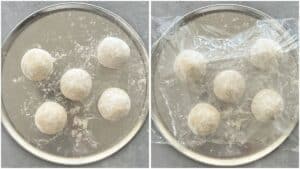
- After 5 minutes, flour your hands well and remove the dough from the mixer. Measure the dough and divide it into 5 equal portions (or 10 small sized ones). Shape them into round balls, cover each one with plenty of flour, and place them on a floured flat tray. Cover with cling wrap and a tea towel (or use a dough proofing box) and let them proof in a warm area for 30 minutes minimum. Best in an oven at 30-40°C (86-104°F).
- Whilst the dough is proofing, in a bowl, combine the zaatar and olive oil. Set aside, this will be used as the topping.½ cup Zaatar, ½ cup Olive oil

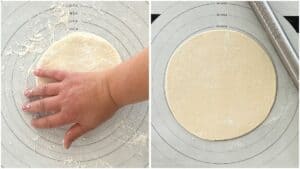
- Take out one dough ball at a time, keeping the others covered to prevent them from drying out. Re-flour the dough if necessary, then place it on a clean, floured flat surface. Flatten the dough ball to about 6" diameter, using the palm of your hands ensuring it stays as even as possible. Then roll it out to about a 24cm (9½") diameter (or half the diameter for the small sized ones) and 3mm (⅛") thick, using a floured rolling pin.
- Using your fingers add dimples to the rolled out dough, avoiding the perimeter (see video). Transfer the dough base to a baking sheet, or bakers peel.Add 1½-2 tablespoons of the zaatar topping, leaving a ½cm (¼") perimeter on the edge.If using a bakers peel transfer it to the bakers stone in the oven otherwise bake in a preheated 250°C (482°F) fan-forced oven for 4-4½ minutes or until the edges are just light golden brown (see notes below). If making the smaller ones, bake for approximately 3 minutes or until light golden brown.Serve the zaatar manakeesh immediately as is (cut up or folded) or filled with fresh veggies. Otherwise wrap in parchment paper (which will keep them soft), they can be kept at room temperature for up to a day or place them wrapped in an airtight container in the fridge for up to 5 days. Reheat in an oven at 250°C (482°F) until warmed through.

Video
Notes
Yield is for 5 medium or 10 small flatbreads. The pictures show the medium size.
I suggest using a silicone mat with markings for different pizza sizes to help guide you on how much to roll out the dough. I also like to use this rolling pin to achieve a precise thickness, each flatbread should not be too thick.
I prefer using a baker's stone and peel to make my zaatar manakeesh. I have included links to these recommended products in the article above. However, it's not necessary to use these specific items, this recipe also works perfectly with a regular baking sheet.
Leftover zaatar and olive oil can be store in an airtight container in the pantry for up to 6 months, but the sooner consumed the fresher it'll taste.
Nutrition
Calories: 644kcal | Carbohydrates: 91g | Protein: 13g | Fat: 27g | Saturated Fat: 4g | Polyunsaturated Fat: 4g | Monounsaturated Fat: 18g | Trans Fat: 0.01g | Sodium: 949mg | Potassium: 307mg | Fiber: 12g | Sugar: 3g | Vitamin A: 899IU | Vitamin C: 12mg | Calcium: 464mg | Iron: 34mg