
Couscous tabbouleh is a Lebanese parsley salad built on couscous instead of the traditional bulgur. Dressed in lemon juice and olive oil so the herbs and not the grain still carry the dish.
What Is Couscous Tabbouleh?
Couscous tabbouleh is my family's tabbouleh with the bulgur swapped for couscous, nothing else touched. Growing up, tabbouleh meant one rule: more finely chopped parsley than anything else with just enough grain to hold it together. A rule my aunt and mom never let slide. Outside Lebanese kitchens tabbouleh usually turns into a grain salad with a bit of parsley thrown in - that's not how we make it!
When I tested the couscous swap that ratio is what I refused to touch. Couscous isn't Lebanese - it's North African. Made from steamed semolina rather than cracked wheat and it takes to the same lemon-and-olive-oil technique without much persuading.
If you want the original recipe my taboule salad is the one my family has made for generations and if you need a gluten-free grain swap instead try my quinoa tabbouleh.
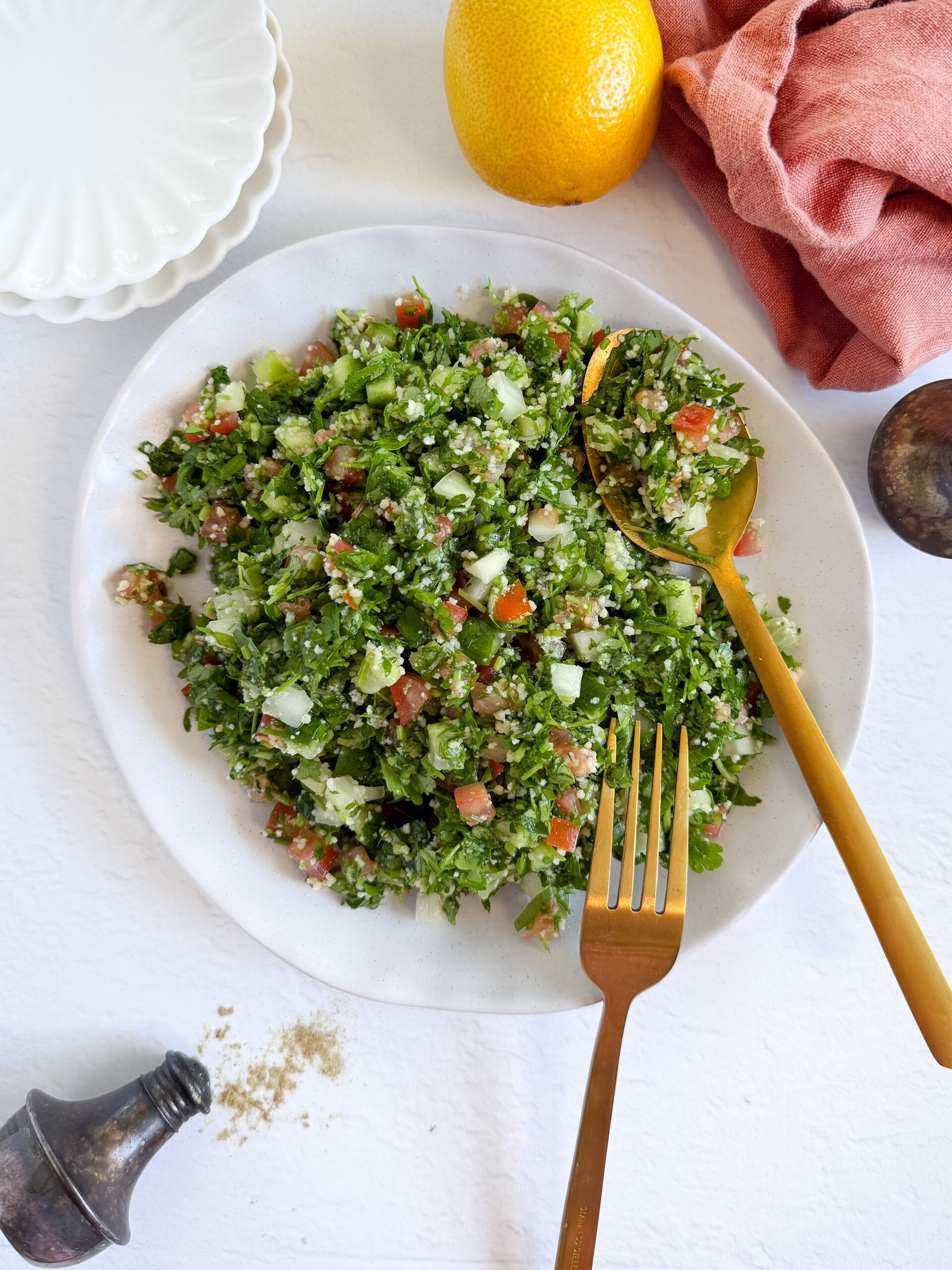
So fresh, juicy and lemony!
Ingredients
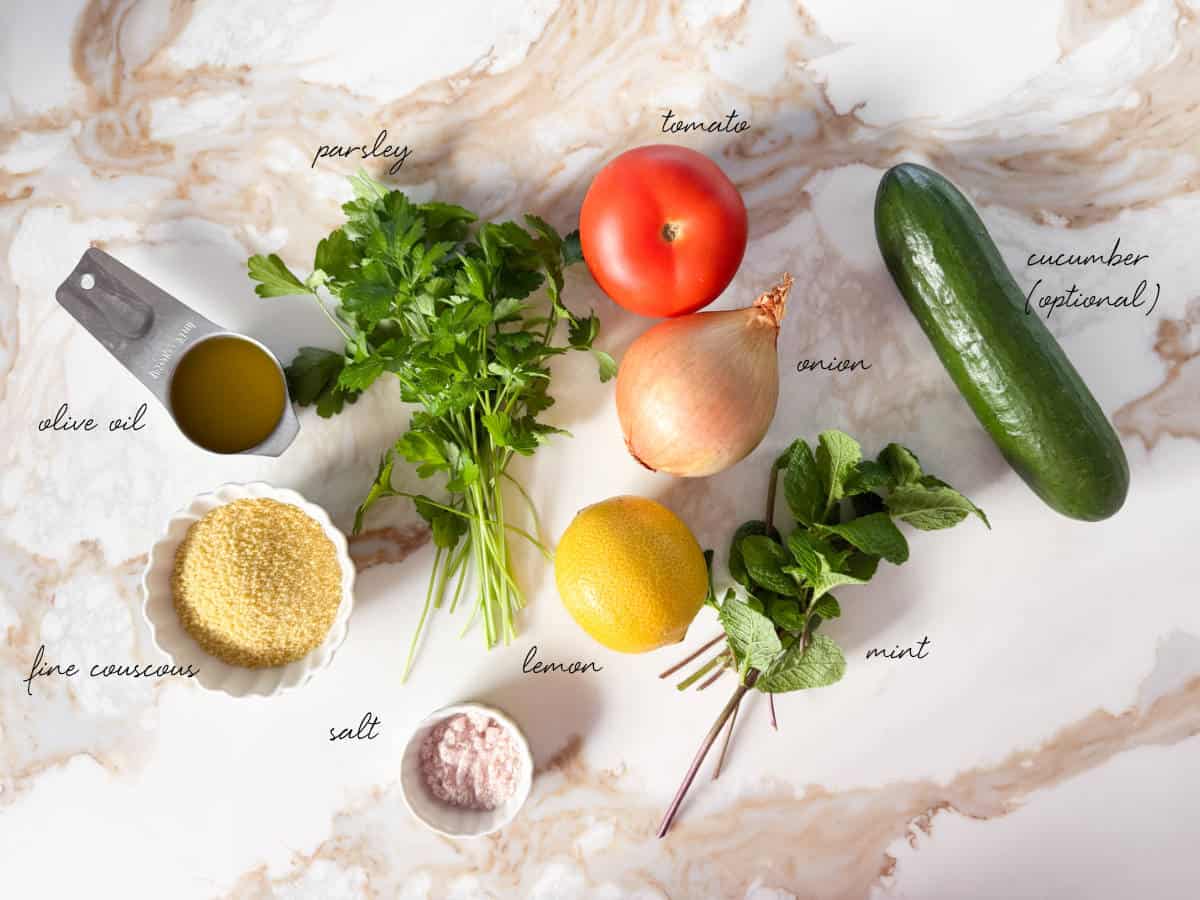
The complete list of ingredients with measurements, can be found in the full recipe card below.
Use flat-leaf (Italian) parsley, not curly - this is basically the whole dish. Wash and dry it thoroughly before chopping or the salad turns wet. Remember to trim out the thick stems. You can save them for stock if you don't want to waste them.
Couscous should be fine couscous, as found in this maftoul salad. Not pearl couscous - as found in moghrabieh. Those are a different product and won't hydrate or fold into the salad the same way. Fine couscous is not gluten-free. I've linked the quinoa version above if that's what you need.
Tomato and onion should be finely diced uniform pieces and not chopped rough. Use tomatoes that are ripe but firm. Soft one turns the salad watery. Onion's role is to bring sweetness and bite through firm crunch.
Mint adds coolness blended through the parsley. Chop it the same fine way as the parsley with no thick stems.
Fresh lemon juice and olive oil make up the dressing. Avoid bottled juice as that tastes flat. A good extra virgin olive oil matters too.
Let's talk about the cucumber. It's not traditional but it's good enough to add into the mix as my Lebanese family does. It adds a bit of freshness. It's optional, but I reckon you should try it once to see how you like it.
Janelle's Tips
- Let the couscous cool completely before mixing it with the herbs. Even slightly warm wilts the parsley and mint and the salad turns limp instead of staying crisp.
- Fluff the couscous with a fork right before adding it to the salad; this keeps the grains separate instead of clumping.
- I now use a chopper (see my below recommendation) to uniformly cut the veggies and it has speed up the process tenfold and it also creates an even cut couscous tabbouleh.
What I Use to Make This Recipe
 Buy Now →
Did you make this? I'd love to know! Leave me a comment below with a ★★★★★ star rating or tag @plantbasedfolk on social media.
Recipe
Couscous Tabbouleh
Ingredients
- ¼ cup Fine couscous
- 2½ cups Flat leaf parsley finely chopped
- 2 medium Tomatoes finely diced
- 1 medium Onion finely diced
- ¼ cup Mint leaves finely chopped
- 2 small Cucumbers finely diced, optional
- 2 medium Lemons juiced (about ¼ cup)
- ¼ cup Olive oil extra virgin
- 1 teaspoon Salt to taste
Instructions
- Place the couscous in a heatproof bowl. Pour ⅓ cup of boiling water over it, cover and let stand for a minimum of 5 minutes until the water is absorbed.
- While the couscous cools, finely chop the parsley and mint. Then finely dice the tomato, onion and cucumber if using.
- In a large bowl, combine the parsley, mint, tomato, onion and cucumber. Fluff the cooled couscous with a fork and add it to the bowl along with the lemon juice, olive oil and salt. Toss well then taste and adjust the lemon, salt, or oil before serving immediately.
Video
Notes
Nutrition
N.B., nutrition info is an estimate based on an online nutrition calculator. This will vary based on the specific ingredients you use.
 If you enjoyed this recipe, consider supporting my work for the cost of a cup of coffee.
Karen
I used to always make tabbouleh with bulgur wheat but the I tried it with quinoa instead for the protein and the recipe I always used was the same as yours with the bulgar as well as the quinoa. This is one of my favorite salads! I Ed been made it one time me for Odeon dance teacher who was Lebanese and she loved it!
Janelle Hama
The other great thing about using quinoa is it's GF. I generally will make regular tabouli or couscous tabouli for my family and set some aside so I can add quinoa to mine. It's the highest tick of approval when someone from the heritage of the food approves, love that!